How goods enter Syria: ports, land crossings and customs in 2026
Short answer: goods enter Syria by sea through the Mediterranean ports of Latakia (containers) and Tartus, or by road through crossings with Lebanon, Jordan, Turkey and Iraq, and are then cleared under a customs law and tariff that took effect on 1 June 2026. Public sources do not yet give clearance times, duty rates or annual container volumes. Information checked on 19 November 2026; sources are at the end.
Key facts
- Latakia container terminal: CMA CGM states it signed a new 30-year concession in May 2025, committed €30 million to a first phase and €200 million to a second, and handles about 95% of Syria’s containerised trade (CMA CGM, 20 August 2025; the 95% is the operator’s own claim).
- Latakia capacity: 250,000 TEU, with a plan to reach 625,000 TEU by the end of 2026; AD Ports Group bought a 20% stake for US$22 million (Maritime Professional, 6 November 2025). A TEU is a twenty-foot-equivalent unit, the standard measure of container volume.
- Tartus: DP World signed a 30-year concession on 13 July 2025 with US$800 million of investment over its term (DP World, 13 July 2025).
- Vessel calls: 92 traceable cargo-vessel calls at Baniyas, Tartus and Latakia in July 2025, against 21 in July 2024 (Lloyd’s List via Kuehne+Nagel, 20 August 2025).
- Foreign trucks: from February 2026 non-Syrian trucks may not enter Syria except in transit; imported goods are transferred at designated border points (The New Arab, 10 February 2026).
- Turkey crossing: about 46,480 commercial trucks and 1.1 million tonnes through Bab al-Salama in the first eight months of 2026 (Daily Sabah, 7 September 2026).
- Customs: Decree 109/2026 (new customs law) and Decree 110/2026 (Harmonized System tariff) took effect on 1 June 2026; implementing regulations were not yet available in June (Germany Trade & Invest, 12 June 2026).
How do goods get into Syria?
Goods reach Syria by sea through the Mediterranean ports, and by road through crossings with Lebanon, Jordan, Turkey and Iraq. The diagram shows the shape of it. It is a schematic, not a map, and it names only the entry points that the sources below describe.
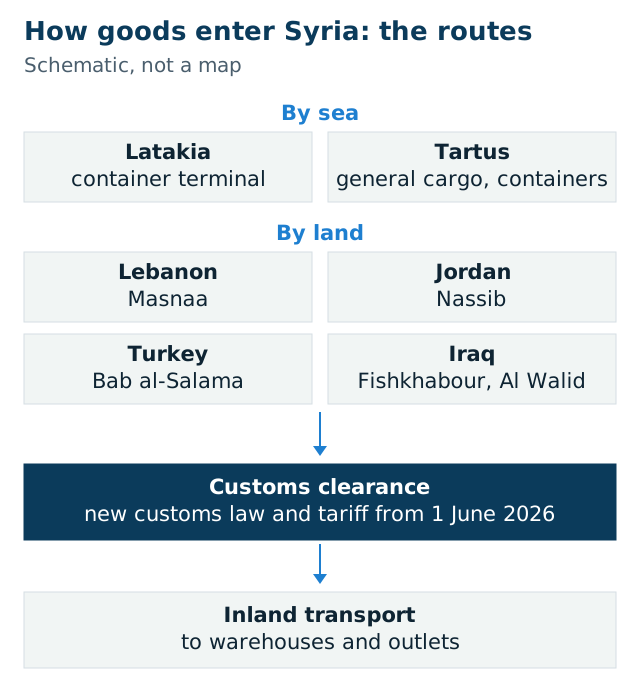
Schematic, not to scale. Sources are listed at the end of this article.
Which ports handle Syria’s sea cargo?
Latakia is the container gateway. (A concession is a long-term right to operate a port facility.) CMA CGM, which operates the Latakia International Container Terminal, states that it signed a new 30-year concession in May 2025 and that the terminal handles about 95% of Syria’s containerised trade. That figure is the operator’s own claim. The company has committed €30 million to a first phase of works and €200 million to a second, and it targets more than one million containers (TEU) a year, against a capacity that Maritime Professional reported in November 2025 at 250,000 TEU, with a plan to reach 625,000 TEU by the end of 2026. In the same report, AD Ports Group took a 20% stake in the terminal for US$22 million.
Tartus is the second port. DP World signed a 30-year concession for it in Damascus on 13 July 2025, with an investment of US$800 million over the term, covering general cargo, containers, breakbulk and roll-on roll-off. We found no public source on what has been built since, and no throughput figure.
Activity has risen. Lloyd’s List, in a report republished by Kuehne+Nagel in August 2025, counted 92 traceable cargo-vessel calls at Baniyas, Tartus and Latakia in July 2025, against 21 a year earlier. The Logistics Cluster, a UN-coordinated body, recorded in its April 2026 meeting minutes that the Latakia and Tartus ports were operational. It gave no capacity or clearance times.
We could not find a verified annual container figure for any Syrian port. Treat any such number you are offered as unsourced until the port authority or operator confirms it.
Which land crossings handle cargo?
By road, the Logistics Cluster minutes of April 2026 describe the Lebanon and Iraq crossings in the table below.
| Neighbour | Crossing | Status reported by the Logistics Cluster, April 2026 |
|---|---|---|
| Lebanon | Masnaa | Handling cargo at full capacity |
| Lebanon | Jousieh | Open mainly for civilian traffic |
| Lebanon | Aboudeyyeh | Under rehabilitation |
| Iraq | Fishkhabour | Main cargo crossing |
| Iraq | Al Walid | Open and fully operational |
| Iraq | Al-Yaroubiyah | Open at limited capacity |
| Iraq | Nisibis | Closed |
Turkey (Bab al-Salama) and Jordan (Nassib) are covered by other sources, not by this table: see the bullets below.
The other two neighbours:
- Turkey: Syria’s ports and customs authority, cited by Daily Sabah in September 2026, reported about 46,500 commercial trucks (in both directions) and about 1.1 million tonnes through the Bab al-Salama crossing in the first eight months of 2026.
- Jordan: reporting in February 2026 described Jordanian trucks unloading at the Nassib free zone. We did not open a source with 2026 volumes for the Jordan crossings.
One rule change matters to anyone planning road freight. In February 2026 Damascus barred non-Syrian trucks from entering the country, except in transit, according to AFP reporting carried by The New Arab on 10 February 2026. Imported goods are to be transferred at designated border points. The same report put traffic from Lebanon at about 500 trucks a day and from Jordan at about 250, and described queues at Masnaa. The stated aim was to regulate cargo movement through the ports. A shipper’s practical consequence is a handover at the border, with a second vehicle and a second set of hands, and this has to be planned and costed.
What changed in Syrian customs in 2026?
Syria’s customs regime was rebuilt twice in eighteen months. According to Germany Trade & Invest (GTAI), unified tariff rates replaced the earlier ones, which had differed by crossing and by area of control, in January 2025. Then, on 1 June 2026, Decree 109/2026 introduced a new customs law of 264 articles, replacing the 2006 law, and Decree 110/2026 introduced a tariff based on the Harmonized System, the international product-classification code, for all imports and exports.
GTAI reports higher, value-based fines, wider anti-smuggling powers and planned digitalisation to speed clearance. It also reports that the implementing regulations were not yet available when it wrote, and that application of the new rules was not yet fully settled. Its advice to exporters is to re-check product classifications under the new tariff and to work with local importers and customs agents. We found no published duty rates, document checklist or clearance-time data from an official Syrian source.
Questions to settle before the first shipment
These are our own suggestions, not findings from a source:
- Which port or crossing will the consignment use, and who is responsible for the handover at the border if it is by road?
- Under the new tariff, what is the Harmonized System code for each product, and who confirms it with customs?
- Who is the importer of record, and which licensed agent clears the goods?
- How long between arrival and release has the partner’s actual experience been, by route, and can it show it?
- What happens to storage and demurrage costs if clearance takes longer than planned?
A distributor that runs import and clearance itself, rather than passing the consignment to a third party, can answer these from experience. Al Takaful’s own account of that stage is on the route to market page.
What is not published?
The public record in November 2026 does not tell a planner how long clearance takes at Latakia or Tartus, what the duty is on a given product line, or how many containers each port handled in 2025. Several local news reports on tariff cuts and import restrictions in 2025 and 2026 appeared in search results but could not be opened, so we have not used them. If a product category matters to you, ask your partner for the current position in writing and check it against the new tariff schedule.
Frequently asked questions
Which port do most containers use to enter Syria? Latakia. Its operator, CMA CGM, says the terminal handles about 95% of Syria’s containerised trade. That is the operator’s own figure; we found no independent annual statistic.
Can foreign trucks drive into Syria? Not since February 2026, except in transit. Imported goods are transferred at designated border points, according to AFP reporting carried by The New Arab on 10 February 2026.
Has Syria changed its customs law? Yes. Decree 109/2026 introduced a new customs law and Decree 110/2026 a tariff based on the Harmonized System, both effective 1 June 2026, per Germany Trade & Invest. Implementing regulations were not yet available when it reported.
How long does customs clearance take in Syria? No public source we opened gives clearance times.
Sources
All accessed 19 November 2026.
- CMA CGM, press release on the second phase of the Latakia port project, 20 August 2025: cmacgm-group.com
- Maritime Professional, AD Ports Group minority stake in Latakia terminal, 6 November 2025: maritimeprofessional.com
- DP World, press release on the Tartus concession, 13 July 2025: dpworld.com
- Lloyd’s List via Kuehne+Nagel, vessel calls at Syrian ports, 20 August 2025: mykn.kuehne-nagel.com
- Logistics Cluster, Syria coordination meeting minutes (meeting of 30 April 2026, published 14 May 2026): logcluster.org
- The New Arab (AFP), “Lebanon, Jordan seek solutions after Damascus bans non-Syrian trucks”, 10 February 2026: newarab.com
- Daily Sabah, Syria-Türkiye crossing traffic in eight months, 7 September 2026: dailysabah.com
- Germany Trade & Invest, Syria’s customs law and tariff, 12 June 2026: gtai.de