The Syrian consumer-goods market in 2026: what is known and what is not
Short answer: Syria’s consumer-goods market is sizeable and changing fast, but it is poorly measured. The World Bank puts the population at 26.0 million (2025) and projects 8 to 10% growth for 2026, yet no public source we could open gives the size of any category of fast-moving consumer goods (FMCG: food, drink, household and personal-care products sold through shops), the split between retail channels, or the number of outlets. Information checked on 19 November 2026; the sources are listed at the end.
Key facts
- Population: 26.0 million in 2025; GDP US$30.6 billion, about US$1,179 per person (World Bank, Macro Poverty Outlook, October 2026).
- Growth: 3.6% in 2025; 8 to 10% projected for 2026, estimated from indicators because there is no official GDP series (World Bank, October 2026).
- Inflation: 27.5% year on year in April 2026; 2026 average projected at 21.4% (World Bank, October 2026).
- Currency: new Syrian pound notes entered circulation on 1 January 2026, with two zeros removed (Al Jazeera, 5 January 2026).
- Returns: more than 1.75 million refugees and 1.97 million internally displaced people returned between December 2024 and the end of July 2026 (World Bank, October 2026).
- Largest urban areas, 2026 estimates: Damascus about 4.4 million, Aleppo 3.0 million, Homs 0.96 million, Latakia 0.60 million (UN DESA, via Worldometer). The last census was in 2004.
- Payments: in May 2026, 94% of surveyed shops accepted Syrian pounds and 47% accepted US dollars (REACH, May 2026).
How many consumers, and where do they live?
The World Bank’s October 2026 Macro Poverty Outlook puts Syria’s population at 26.0 million (2025) and its GDP at US$30.6 billion, or about US$1,179 per person. Those are the headline numbers; two cautions come with them. The last census was in 2004, and years of displacement and return since then mean that nobody has a reliable count of where people live today.
The best available city figures are modelled estimates. UN urban-agglomeration estimates for 2026 put Damascus at about 4.4 million people, Aleppo at 3.0 million, Homs at 0.96 million and Latakia at 0.60 million. The first three alone add up to roughly a third of the national population on the same estimates, which is why distributors tend to think in terms of a few large consumer centres plus a long tail of smaller towns.
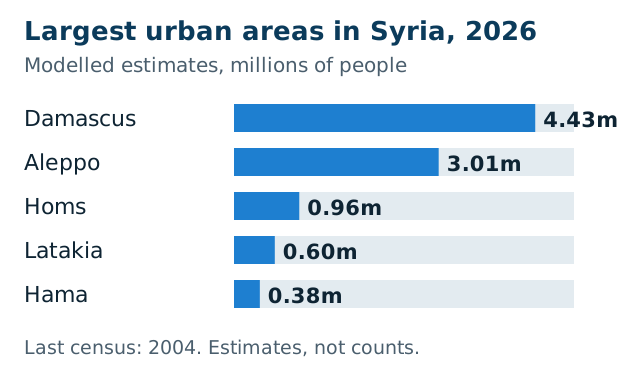
Source: UN DESA World Urbanization Prospects 2025, urban-agglomeration estimates for 2026, as published by Worldometer (accessed 19 November 2026). Modelled estimates, not census counts; the agglomeration and administrative-city definitions differ.
How urban Syria is today is genuinely unresolved. The estimate we opened puts the urban share at 72%, and other sources we found disagree. We do not quote a single figure.
What is happening to prices and the currency?
The World Bank reports growth of 3.6% in 2025 and projects 8 to 10% for 2026. Because there is no official GDP series, it relies on indicators such as cement output and night-time lights. Read the projection as direction, not as a measurement.
Prices matter more to a distributor than growth does. The same outlook records inflation returning to 27.5% year on year in April 2026, with a 2026 average projected at 21.4%.
The currency has also changed. The government has redenominated it: new Syrian pound notes entered circulation on 1 January 2026, with two zeros removed (100 old pounds became one new pound), according to Al Jazeera. In May 2026 REACH’s market monitoring (a joint initiative of the research organisation IMPACT that surveys shops across Syria) recorded a median informal rate (the exchange rate in the unofficial market) of 13,400 pounds to the dollar, about 15% weaker than in February, though it is not clear whether that figure is in old or new units.
The practical point is the one REACH reports: the market has become multi-currency. Of the shops it surveyed in May 2026, 94% accepted Syrian pounds and 47% accepted US dollars (36% in April 2025). A price list, a credit term or a margin target fixed in a single currency will drift.
How much can Syrian shoppers spend?
Demand is rising from a low base. The World Bank counts more than 1.75 million refugees and 1.97 million internally displaced people returning between December 2024 and the end of July 2026, which it says supports demand. It also notes that the minimum wage, raised in May 2026, still covers less than half of the minimum expenditure basket.
Two Syria-based executives interviewed by Oxford Business Group’s 2026 country report describe the commercial result. One says buying has shifted from “availability-driven” to selection-based, because goods are now broadly available. The other says that with affordability limiting demand, price, reliability and distribution coverage count for more than premium positioning. We read these as the views of participants, not as measurements, but they point the same way as the price data.
How is Syrian retail organised?
Here the public record is weakest. The one source we could open on the topic, a Catalan trade-agency market profile, describes modern retail as limited, with few supermarkets or hypermarkets and small retailers dominant. It also says there is no reliable chain-level or market-share data, and the page appears to rest on older information.
REACH’s vendor survey adds a useful signal about how those retailers behave. In May 2026 shops reported holding less stock, relying more on a single supplier, and fewer of them offering credit. A distributor financing small outlets is therefore carrying more of the working-capital burden than in a market where retailers hold their own stock.
What is not publicly known about the Syrian FMCG market?
Be wary of any report that gives a precise market size. We could not find a public source for:
- the value or volume of any FMCG category;
- the split between traditional, modern and informal channels;
- the number of outlets nationally;
- official household income and spending data since 2011;
- a current census.
Anyone offering a number for these should be asked for the method.
What should a brand owner do with this?
The case for Syria rests on population, returning households and a market that is opening to imports. The case against is the lack of hard data and the currency risk. Those are different kinds of uncertainty and should be treated differently. Population and demand are slow-moving and can be sized with ranges. Currency and credit terms change quickly and need to be written into the commercial agreement and revisited often.
For a regional director, a sensible first step is a short list of questions for any prospective partner: how its price lists adapt across currencies, how much credit it extends and to whom, and how it counts its outlets. The article on questions to ask a distributor is a starting point.
Frequently asked questions
How big is the Syrian FMCG market? No public source we opened gives a market value or volume for any FMCG category. The available context is population (26.0 million, World Bank, 2025) and income (about US$1,179 per person), not sales.
Is Syria’s economy growing? The World Bank projects 8 to 10% growth for 2026 after 3.6% in 2025, but says there is no official GDP series and relies on indicators such as cement output and night-time lights.
What currency do Syrian shops accept? Both. In May 2026, 94% of surveyed shops accepted Syrian pounds and 47% accepted US dollars, up from 36% for dollars in April 2025 (REACH).
Where do most Syrian consumers live? No current count exists. UN estimates put about a third of the population in the three largest urban areas, Damascus, Aleppo and Homs, but these are modelled and the last census was in 2004.
Sources
All accessed 19 November 2026.
- World Bank, Macro Poverty Outlook: Syrian Arab Republic, October 2026: thedocs.worldbank.org
- Worldometer, largest cities in Syria (UN DESA World Urbanization Prospects 2025): worldometers.info
- Worldometer, Syria population (UN DESA World Population Prospects 2024): worldometers.info
- Al Jazeera, “Syria’s new currency removes al-Assad family images”, 5 January 2026: aljazeera.com
- REACH / IMPACT, Joint Market Monitoring Initiative, Syria, May 2026: repository.impact-initiatives.org
- Oxford Business Group, The Report: Syria 2026, interviews with Firas Shammas (New Allied Distributors) and Hadi Joud (Joud Company): Shammas, Joud
- ACCIO (Catalonia Trade and Investment), Syria: distribution: tradeportal.accio.gencat.cat