Route to market in Syria: one distributor, regional sub-distributors or direct?
Short answer: there is no public evidence that one route to market beats the others in Syria. A single national distributor offers simplicity and one point of accountability; regional sub-distributors offer deeper local reach at the price of complexity; selling direct keeps control and data but puts stock, vehicles and credit risk on the brand. The choice turns on how fast you need reach, who funds working capital and how much management time you can commit. Information checked on 19 November 2026; sources are at the end.
A route to market is the chain of companies and people that moves a product from the brand owner to the shop. A sub-distributor is a smaller distributor, usually regional, that buys from a larger one. Channel conflict is what happens when two parts of that chain compete for the same customer.
Key facts
- Indirect networks are standard in emerging markets. Globalpraxis says networks of master distributors, sub-distributors, wholesalers and traditional retailers are essential for coverage, speed and availability, and that distributors fund inventory and carry credit risk.
- Cost to serve differs by tier. The same source says a metropolitan master distributor and a rural sub-distributor have different cost structures, and rural traditional trade costs more to serve.
- Syria-specific gaps. Two executives interviewed by Oxford Business Group for The Report: Syria 2026 name storage, cold chain, logistics and payments as constraints.
- Buying has changed. One interviewee says Syrian buyers have moved from availability-driven to selection-based purchasing.
- Credit is tightening at the shop. In May 2026, REACH found shops holding less stock, relying more on a single supplier, and fewer offering credit.
- One public example of the single-distributor model. A Business Wire release of 9 October 2025 announced DistriMart/GulfMed Supply as exclusive distributor of SC Johnson products in Syria, claiming 11,500 outlets and 205 vehicles (company claims, unverified).
A disclosure first: Al Takaful is a distributor, so we have an interest in this question. We have therefore leaned on outside sources where we could and labelled our own reasoning as ours. The honest position is that public evidence comparing these models in Syria barely exists. What follows is a framework built from the sources we could open, not a study.
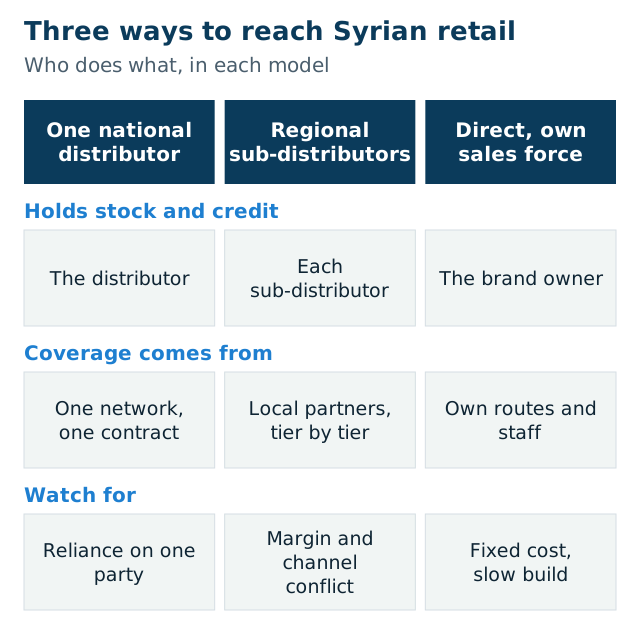
Our summary diagram; the content draws on the sources listed below and on our reading of them.
What does the evidence say about distributor models?
Globalpraxis, a consultancy that works on FMCG distribution in emerging markets, argues that indirect networks of master distributors, sub-distributors, wholesalers and traditional retailers are essential for coverage, speed and availability in those markets. Its description of the distributor’s position is useful. Distributors are independent businesses driven by profit. They fund inventory, carry credit risk and run local logistics. Their margins should match their role, because a metropolitan master distributor and a rural sub-distributor have different cost structures, and the cost of serving rural traditional trade is higher.
The same source lists how it goes wrong. Promotions can push a distributor’s gross margin below break-even. High inventory strains cash. Late rebates hurt liquidity. And where direct and indirect coverage overlap, or urban and rural, or traditional and modern, channel conflict and undercutting follow. The article gives no figures and does not compare direct and indirect economics.
Two Syria-based executives interviewed by Oxford Business Group in 2026 add the local conditions. One, a distributor’s chief executive, says storage, cold chain and logistics are still gaps, and that buyers have moved from availability-driven to selection-based purchasing. The other, a producer’s general manager, says price, reliability and distribution coverage now matter more than premium positioning, and that a functioning payments system is essential, noting that practical financial channels can lag after formal restrictions ease.
Finally, one example of the single-distributor model is public. In October 2025 a Business Wire release announced that DistriMart/GulfMed Supply, part of Dishley Holding, had become the exclusive distributor of SC Johnson products in Syria. The release states that it serves 11,500 outlets across all Syrian governorates with 205 vehicles. Those are the company’s own claims, which we have not verified, and the contract terms are not public.
How does a single national distributor model work?
One partner holds the stock, extends the credit, runs the vehicles and answers for the result. The brand owner has one contract, one invoice flow and one set of numbers to review.
The strength is simplicity and clear accountability. The weakness is dependence. If the partner’s coverage has gaps, the brand has the same gaps. Whatever the distributor claims about its reach, the brand should ask to see how that reach is counted: outlets by name, by region and by date, not a total.
How do regional sub-distributors work?
Here the brand, or a lead distributor, appoints local partners region by region. Coverage can be deeper where local knowledge counts, and each partner carries the credit risk of its own customers.
The cost is complexity. There are more contracts, more margins, more payment relationships and more data to reconcile. Following the Globalpraxis points above, the risks are margin erosion, cash strain and channel conflict when territories overlap. This model rewards a brand with the management time to run it.
What does selling direct involve?
The brand sells to shops with its own staff and fleet. It keeps the customer relationship and sees the data first-hand.
It also carries the cost: vehicles, staff, warehouses, stock financing and credit risk on many small accounts. REACH’s May 2026 survey found that fewer Syrian shops now offer credit and that stock cover has shortened. In that setting a direct model means financing small outlets. We found no public figure for what that costs in Syria, nor in any comparable market, so any claim of a clear cost advantage either way should be treated as unproven.
How do the three models compare?
| Model | In brief |
|---|---|
| One national distributor | Holds stock and credit: the distributor. Strength: simple, one point of accountability. Risk: dependence on one party’s coverage. |
| Regional sub-distributors | Holds stock and credit: each sub-distributor. Strength: local knowledge and depth. Risk: margin erosion, cash strain, channel conflict. |
| Direct | Holds stock and credit: the brand owner. Strength: control of the customer relationship and data. Risk: fixed cost, slow build, credit risk on small accounts. |
This table is our synthesis of the Globalpraxis framework and the interviews above; no source compares the three models side by side.
How should a brand choose?
These are our questions, not a formula:
- How fast do you need reach, and how deep? Sub-distributors and distributors with existing networks reach farther quickly; direct is slow to build.
- Who will fund working capital? Whoever holds stock and credit carries the risk. Decide it on purpose.
- What data do you need, and how often? If you need outlet-level sell-through, write that into the contract, whichever model you choose.
- How much management time can you commit? More partners means more to supervise.
- How will you handle payments and currency? The market is multi-currency, as the market overview sets out. Credit terms, price lists and the settlement route are part of the model, not an afterthought.
Whichever route you pick, the checks in questions to ask a distributor apply: how reach is counted, who holds stock, and what the partner will show you before you sign.
What is not known?
We found no opened source that quantifies direct versus distributor cost to serve, typical margins or credit terms in Syria. Nothing we opened describes how other multinational brands structure their Syrian distribution. Several consulting reports on route-to-market in emerging markets appeared in search results but could not be opened, so we have not cited them. A brand owner should treat any firm number on these questions as needing a source.
Frequently asked questions
Should a brand use one distributor for all of Syria? It is the simplest model, with one contract and one set of numbers, but coverage depends entirely on that partner. Ask how its reach is counted, by outlet, region and date, before signing.
What is a sub-distributor? A smaller, usually regional distributor that buys from a larger one and serves local wholesalers or shops. Margins should match the role, because costs differ between city and rural tiers (Globalpraxis).
Is selling direct cheaper than using a distributor in Syria? We found no public figure for either option in Syria or in a comparable market, so a claim of a clear cost advantage is unproven.
Why does credit matter in the choice? Whoever holds stock and credit carries the risk. REACH found in May 2026 that fewer Syrian shops offer credit, so a direct model means financing small outlets itself.
Sources
All accessed 19 November 2026.
- Globalpraxis, “Why understanding distributor economics is critical in FMCG indirect channels”: globalpraxis.com
- Oxford Business Group, The Report: Syria 2026, interviews with Firas Shammas and Hadi Joud
- Business Wire (syndicated), “DistriMart/GulfMed Supply becomes exclusive distributor of SC Johnson products in the Syrian Arab Republic”, 9 October 2025: markets.financialcontent.com
- REACH / IMPACT, Joint Market Monitoring Initiative, Syria, May 2026: repository.impact-initiatives.org